
Faces that read well on camera: a lighting fix for Marcus's local news desk
A short account of how a small regional news team stopped fighting shadows and glare, and what a simple key, fill and backlight plan changed for presenters and camera operators alike.
A call about faces, not equipment
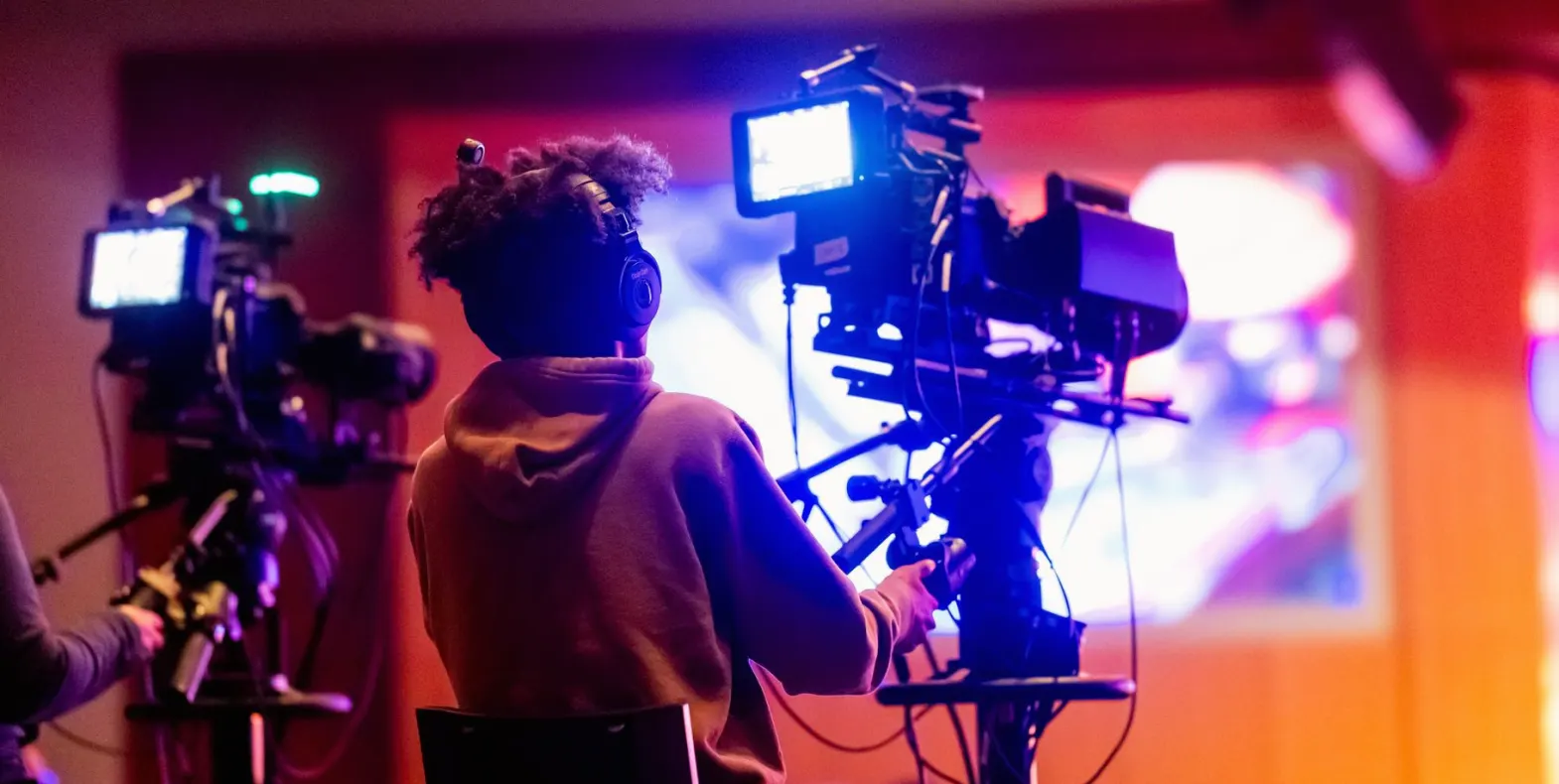
Marcus runs the technical side of a small regional news studio, and when he first rang us he did not ask for new lights. He asked why his presenters looked tired on screen by the second bulletin. I went to York's side of the county to see for myself, and I took one camera operator's habits into account from the first minute, because I spend most of my working week with cameras and I know how quickly a lens exposes a poor lighting plan.
The studio had a handful of fixed fixtures bolted to a grid, installed years earlier for a different set. Nothing was broken. Everything simply pointed at the desk from roughly the same angle, which flattened faces and threw a hard shadow under every chin. Marcus had noticed the effect but assumed it was the cameras.
That assumption is common, and it is worth saying plainly: when a picture looks wrong, the first suspect is usually the light, not the camera.
What we found when we stood on the set
We spent the first visit watching rehearsal rather than measuring anything. Two presenters sat at the desk, one taller with glasses, one shorter with a darker complexion, and the single lighting state was a compromise that suited neither. The taller presenter's lenses carried two bright reflections, and the shorter presenter sat slightly too deep in shadow.
Daniel, our lighting designer, joined for the second visit and walked the grid with Marcus. Several fixtures could not be dimmed independently, so any adjustment moved the whole picture at once. The set background was also lit at the same level as the faces, which pulled the eye away from the people.
None of this needed a rebuild. It needed a plan that treated each job in the picture separately.
- Flat frontal light with no clear key direction
- Glasses reflections on the taller presenter
- Background as bright as the faces
- Fixtures that could not be dimmed one by one
Key, fill and backlight, in plain terms
The plan we wrote for Marcus rests on three roles. The key light is the main source and gives the face its shape; we moved it up and about thirty degrees to one side of each camera, which removed the chin shadow and shifted the glasses reflections out of the lens. The fill light is softer and sits on the opposite side, there only to lift the darker areas without erasing the shape the key has made.
The backlight comes from behind and above, and it separates the shoulders and hair from the set so the presenter does not melt into the wall. We kept it modest, because too much backlight makes hair glow in a way viewers notice for the wrong reasons.
Each role went onto its own dimmer channel, so a change to one never disturbed the others.
Working with two different presenters
The more useful part of the visit was adjusting for the two people actually sitting there. With a single flat state, the taller presenter was lit well and the shorter one was not. Once the channels were separate, Daniel could trim the fill on one side and lower the key slightly for the other, so both read comfortably on the same shot without anyone moving.
I checked this from behind the cameras, as I would for any operator, matching exposure between the wide shot and the close shots. The aim is that the picture holds when the director cuts between angles, and that nobody in the gallery has to rebalance the image mid-bulletin.
Marcus watched the monitor change as each channel came up, and said it was the first time he had understood what each fixture was for.
Heat, power and a quieter studio
Daniel also looked at the practical side that rarely gets mentioned in a brief. The old fixtures ran hot, and the studio warmed noticeably during a long morning of live inserts, which made presenters uncomfortable and the room harder to cool. Dimmable fixtures draw less when they are not at full output, and most of the set did not need full output at all.
We swapped only the fixtures that mattered most, the key and fill positions, and kept the existing backlights after retargeting them. That kept the work proportionate and let the team keep using equipment they already trusted.
Marcus later told us the room felt calmer, which is hard to measure but easy to notice when you spend ten hours a day in it.
What Marcus took away from it
A few weeks on, Marcus sent a short note rather than a long review. The presenters no longer asked for different make-up between bulletins, the glasses reflections had gone, and his operators spent less time compensating at the camera for what the lighting had left undone.
I would not describe that as a transformation, and Marcus would not either. It was a set of small, sensible decisions made in the right order: look at the faces first, give each light one job, and make every job adjustable on its own.
The same sequence applies to larger studios, though the number of fixtures changes. The method stays the same whatever the size of the grid.
- Look at faces on camera before touching a fixture
- Give key, fill and backlight separate dimmer channels
- Retarget existing lights before buying new ones
- Check exposure across every camera angle
Marcus's studio did not need a bigger budget, only a plainer way of thinking about light. Separate the key, fill and backlight, make each one adjustable, and check the result on the cameras your viewers actually see through. If your presenters look tired or your operators are always correcting, the lighting plan is a sensible place to begin, and a visit to the set usually tells us more than any drawing.